


Overview
Founding Philosophy
Humanity is currently facing a number of challenges to its continued existence caused by a range of factors. Can we or future generations continue to live on this planet in the same way and with the same values we've held up to now? How can we resolve such problems that have historical and social origins? And in the 21st century, what form should our culture, science, and technology take? There are no set methods for developing ideas when it comes to such challenges.
The founding philosophy of the International Institute for Advanced Studies (IIAS) is to "conduct research for the future and happiness of mankind,” and we address these issues through fundamental research based on cooperation among government, industry and academia. By consolidating wisdom from around the world and taking research forward, we aim to produce new directionality in academic research or orient ourselves towards creating new concepts, and contribute to the development of academic research culture.
At the time of its establishment, IIAS made it its policy to provide highly talented researchers from different countries and fields of research with an environment conductive to completely free interaction and discussion. As such, we have been placing importance on the following four pillars.
1.Being an international research institute
2.Implementing fundamental research in progressive fields and issues
3.Ensuring that research topics and researchers remain flexible
4.Cooperating with industry
History
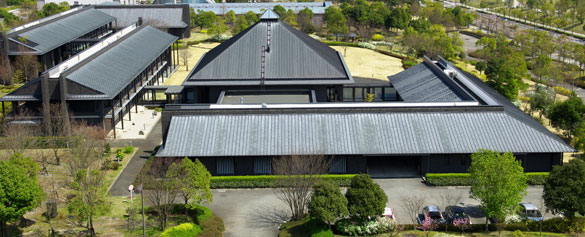
IIAS was established in August 1984 as an incorporated foundation strongly supported by entities from industry, academia and government that agree with its founding philosophy outlined above, and has since been running on donations from major companies and philanthropists across Japan. In October 1993, IIAS opened a research facility in the Keihanna Science City (officially known as Kansai Science City) on a land granted by the Kyoto Prefectural Government. The Institute serves as the central research organization or the "brain" of the Keihanna Science City.
Our Connection with Society
In April 2013, IIAS became a public interest incorporated foundation—a change that called for increased efforts to listen to the voice of society and carry out activities that are publicly beneficial in the eyes of the society. This led to the establishment of IIAS Strategic Committee (ISC), which aims to help us recall our origin, put our fundamental philosophy and core identity into practice, develop a medium- to long-term master plan that will allow us to continue to meet our responsibility to the society, as well as to lay foundations for doing these. The ISC will work to identify and interpret the changes in society and create our own strategic business model—built around IIAS researches and designed to help actively communicate and apply research results to the society— so as to develop a clear master plan.
We have, as part of our activities, been a keen participant in the project to develop “Keihanna Open Innovation Center @Kyoto (KICK, housed in the former “Watashi no Shigoto-Kan”)” from its planning stage, offering ideas for the Center’s operation and research themes. Our “Keihanna Philosophy Café ‘Goethe no Kai’” is a platform for people who work at organizations located in or related to the Keihanna Science City to meet and discuss topics such as the desirable shape and function of the Keihanna Science City, freely and from an independent perspective. Through these and other activities, IIAS will continue to serve its role as the intellectual hub and the core facility of the Keihanna Science City.